Press releases
For hygienically clean plastic tableware: Miele Professional’s laboratory puts its own dishwashers to the test
-
Repeating tests five times to ensure reliable results
-
Recommendations for consumers, service and sales personnel
Miele Professional offers fresh water dishwashers from the “MasterLine” series for the reliable cleaning and drying of plastic tableware such as feeding cups and medicine cups. But how can you test whether these cups are being cleaned in such a way that they pose no risk to residents of care homes? Diana Klapper has the answers to questions like these. She’s responsible for carrying out hygiene tests and chemical-analytical research at the Miele plant’s application-technical laboratory in Bielefeld. She finds solutions for Miele Professional’s consumers and various in-house departments. A look behind the scenes.
“Laboratory work begins and ends at the office desk; it involves thorough preparation and follow-up work,” says the biotechnology graduate. Since 2001, Diana Klapper has been responsible for testing and evaluating dishwasher hygiene in the Professional Business Unit – from before market launch and throughout the entire “lifetime” of a product. That’s why the engineer, together with her eight colleagues in the CustomerSolutionApplication department (CSA), is ready to answer such questions. They regularly receive enquiries from the catering trade, care facilities and other commercial customers such as nurseries. However, their work doesn’t just revolve around processing customer enquiries. As well as resolving application-technical issues, the CSA team also works on the product development process which deals with the suitability of various materials and surfaces. “If leftover food gets stuck in the machine, it makes it easy for germs to multiply,” explains Diana Klapper.
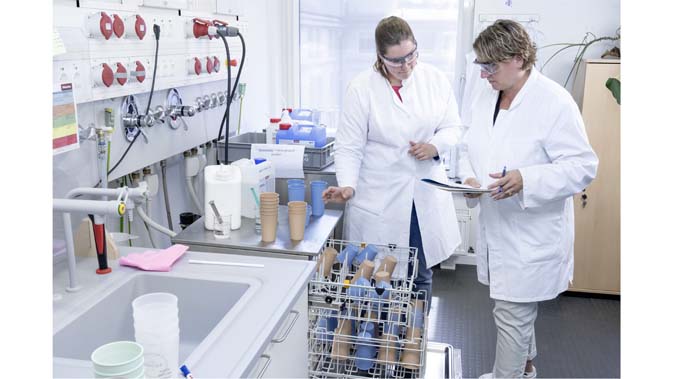
As well as focusing on the requirement to guarantee the highest level of safety for end consumers in everyday life, the topic of “user-friendliness” is a central focus for the expert. To this end, she and her colleague Mathilde van Rheenen are trialling the conditions under which a commercial dishwasher not only cleans reusable cups hygienically, but also reliably dries them at the end of the procedure. This is achieved via a special basket with suitable holders. The basket has been tested on an application-technical basis in the CSA laboratory and is now on the market. Cups from different manufacturers often need to have their residual moisture tested under real conditions and therefore find their way onto the “testing bench”. As part of the application tests, the reusable REBOWL and RECUP products were also evaluated in Miele Professional’s MasterLine fresh water dishwashers with Dry+. The cleaning results and complete drying also impressed RECUP.
Repeating tests five times for statistically reliable results
Diana Klapper carries out at least five washing tests for each application in order to obtain statistically reliable results: “To answer a question, we can assess various parameters,” she says. “This might also include the quantities of rinse aid and detergent used.” The results of the application-technical tests are then documented and the load items are photographed. “Documenting the results actually takes longer than the washing itself.” With a twinkle in her eye, she refers to her meticulous approach as “professional mistrust”.
The professionals working at Miele carry out the demanding tests on microbiological and hygienic issues rigorously and in accordance with standards. If, for example, they wish to assess whether plates are hygienically clean, they use test pieces made from brushed stainless steel. Diana Klapper has to “contaminate” them manually first with a standardised starch solution that contains a specific amount of bacteria. She attaches the prepared test pieces to the test plates using special stainless steel holders and then starts the wash programme they are testing. Once the process being tested is complete, she removes the test pieces from the holders and analyses them microbiologically to determine the number of remaining bacteria. This shows the expert whether most of them have been removed – or whether the wash cycle or process chemicals used need to be “improved”.
“External laboratories are also involved in our testing processes,” reports Diana Klapper. “But the initial tests are always carried out directly at Miele Professional in Bielefeld, so that we can immediately identify any ‘snags’ and optimise them if necessary.” The usability laboratory on the same floor determines whether dishwashers and their processes are suitable for long-term everyday use by customers. Models of the latest design are lined up here, ready to prove themselves in tests ranging from cleaning and drying performance to energy consumption and endurance tests. “The interaction between the dishwasher and the load items has to be right. Our results benefit both the finished product as well as users and end customers,” says laboratory manager Ralf Voßhans. “And we’re always happy to pass on our results and findings from the many tests we carry out together as application-technical information,” adds Diana Klapper. “That way, the Miele Professional service and sales teams are always kept up to date.”
About Miele: For more than 125 years, Miele has lived up to its brand promise of “Immer Besser” in terms of quality, innovation and timeless elegance. Founded in 1899, the globally active company for premium domestic appliances inspires customers with pioneering solutions for the connected home. In addition, Miele offers appliances, systems and services for commercial use, such as in hotels or care facilities as well as in medical technology. With its durable and energy-saving appliances, Miele helps its customers make their daily lives as sustainable as possible. The company is owned by the two founding families, Miele and Zinkann. In the 2024 business year, Miele generated a turnover of 5.04 billion Euros with approximately 23,500 employees. Its global network comprises 19 production plants and around 50 service and sales subsidiaries (as of February 2025). The company has its headquarters in Gütersloh, North Rhine-Westphalia.
Anke Schläger
+ 49 5241 89-1949
anke.schlaeger@miele.com
Media information
| Description | Download |
|---|---|
Meticulous preparation and follow-up of the washing tests is a “must”: Diana Klapper (right) documents the results with her colleague Mathilde van Rheenen. (Photo: Miele) |
|
| High Resolution JPG | |
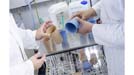
Is everything dry? Once the programme is complete, every single reusable cup is put to the test. Damp reusable cups are a hygiene risk and can transmit germs. (Photo: Miele) |
|
| High Resolution JPG | |
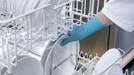
Diana Klapper attaches “contaminated” stainless steel test pieces to plates using special holders. The microbiological result is determined in five separate washing tests that are then used to calculate an average value. (Photo: Miele) |
|
| High Resolution JPG | |
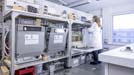
Miele Professional dishwashers are put to the test in the usability laboratory as well. (Photo: Miele) |
|
| High Resolution JPG |