Press releases
Miele’s decades-long commitment to repairability
-
Around 250,000 repairs and maintenance jobs every year in Germany
-
70,000 original spare parts available for at least 15 years after production of the series has ended
-
New EU rules aim to make repairs more cost-effective
For decades, Miele has embodied the very principles that underpin the EU’s Right to Repair Directive: durable products that can be repaired. The new EU rules aim to make repairs more cost-effective for consumers. Greater cost transparency and improved access to repair information are also intended to encourage greater willingness to have appliances repaired, thereby extending their service life.
With the transposition of the Directive into national law, requirements regarding repair information and services now apply to appliances such as washing machines, washer-dryers, tumble dryers, dishwashers, refrigerators, freezers and vacuum cleaners.
According to the representative study "Repair rather than throw away" by Wertgarantie,¹ only 23 percent of faulty electrical and household appliances in Germany are repaired. Of the consumers surveyed, 31 percent say they decide against a repair because repair costs are too high.
“The Right to Repair Directive addresses a key issue: repairs have to be more appealing for consumers and make economic sense,” says Axel Kruse, Senior Vice President Customer Service at Miele. “Durability, repairability and the long-term availability of spare parts have been an integral part of Miele’s ethos for decades.”
Service as a contributor to longevity
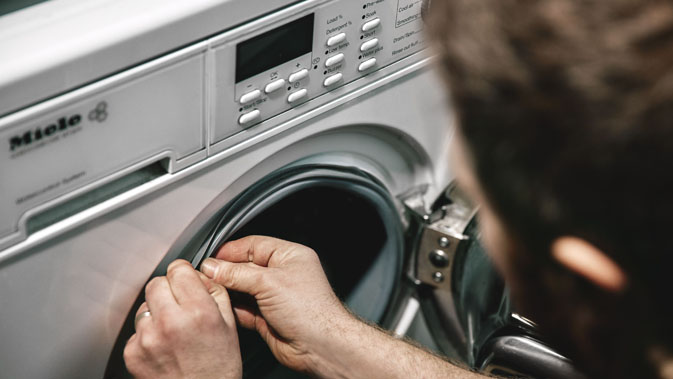
With around 250,000 repairs and maintenance jobs carried out each year in Germany, service has been one of Miele’s core strengths for decades. Long-term availability of original spare parts plays a key role in this: around 70,000 spare parts remain available for at least 15 years after production of the series has ended. Customers can purchase many parts directly and carry out minor maintenance or repair work themselves with the help of more than 250 DIY videos on YouTube. Miele’s Remote Assist Service provides additional support by analysing selected faults via remote diagnosis and, where technically possible, rectifying them directly. If an on-site visit is required, Miele’s own nationwide Customer Service organisation, staffed by trained service technicians, provides rapid assistance. The first-time fix rate shows that this approach works: in 2025, 87 percent of all repairs were successfully completed during the first service call. Independent repair businesses are also included in the network. As registered “Professional Repairers”, they are given access to repair information and genuine spare parts.
German consumer organisation Stiftung Warentest has also highlighted the fact that repairability is increasingly viewed as a mark of quality. In its first-ever assessment of washing machine repairability (test 11/2025), Miele was awarded an overall mark of 1.9 (on a scale where 1.0 is best) for its WWB 380 WPS 125 Edition model. In the assessment of repair support, Miele was the only manufacturer to be rated “very good” by Stiftung Warentest.
Repairs conserve resources
Often, replacing individual components, such as electronic units, pumps or typical wear parts, is enough to extend the service life of a household appliance. Furthermore, Miele uses professionally reconditioned spare parts for selected repairs. Around 10,000 electronic components are refurbished and put back into use every year. At the same time, this helps conserve resources and offers customers a cost-effective alternative. Depending on the spare part, costs can be up to 30 percent lower than for a new part.
The EU’s Right to Repair Directive reinforces this approach and makes an important contribution to the circular economy. Yet repair has been an integral part of Miele’s product and service philosophy for decades. The new rules can help keep high-quality household appliances in use for longer and reduce resource consumption over their entire life cycle. This depends on the requirements being implemented as consistently as possible across Europe and being straightforward and practical for consumers to apply.
1 Wertgarantie: Reparieren statt Wegwerfen [Repair rather than throw away]. A study by WERTGARANTIE SE on the generation of electronic waste. Germany 2025. Hannover, 2025. Available at: https://reparieren-statt-wegwerfen.de/die-studie/
About Miele: Since 1899, Miele has lived up to its brand promise “Immer Besser” in terms of quality, innovation, and timeless elegance. The globally active company for premium domestic appliances delights customers with pioneering solutions for the connected home. In addition, Miele offers appliances, systems and services for commercial use, such as in hotels or care facilities as well as in medical technology. With its durable and energy-saving appliances, Miele helps its customers make their daily lives as sustainable as possible. The company is owned by the two founding families, Miele and Zinkann. In the 2025 business year, Miele generated a turnover of 5.16 billion Euros with approximately 23,000 employees. Its global network comprises 19 production plants and 49 service and sales subsidiaries (as of March 2026). The company has its headquarters in Gütersloh, North Rhine-Westphalia.
Irene Schwarze
+49 5241 89-1959
irene.schwarze@miele.com
Media information
| Description | Download |
|---|---|
Repair, don’t replace: trained service technicians ensure that household appliances can be used for as long as possible. (Photo: Miele) |
|
| High Resolution JPG | |

With a nationwide in-house Customer Service organisation and around 250,000 repairs and maintenance jobs carried out each year in Germany, service has been one of Miele’s core strengths for decades. (Photo: Miele) |
|
| High Resolution JPG | |
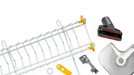
Around 70,000 genuine spare parts remain available from Miele for at least 15 years after production of the series has ended. (Photo: Miele) |
|
| High Resolution JPG |